Adventure Nomad

Adventure Nomad

Wednesday, July 25, 2007

Adventure Singapore: Tampines Bike Trail

I thought I’d try to write something to introduce some of the adventure playgrounds in Singapore. In case you are not familiar with Singapore, it is a tiny island nation, which is home to 4.5 million people. It is crowded, and one of our challenges is how to share land use.

The Tampines Mountain Biking Trail is a newly created Mountain Biking Park is located in the heart of Tampines, just 1km from Tampines Mall. The entrance to the park and parking lot are located along Tampines Avenue 9 at the junction of Tampines Avenue 7. The basic trail is only 5.5km long although parts of this trail are currently under repair from the last rainy season.

Typical of other man-made bike parks, the trails are designed to maximize the use of space within the confines of the park. There is also a free ride area, built by volunteers, but otherwise, the trails offer relatively risk-free riding, and are ideal for a quick ride before or after work.

The park is still being developed, and only 30% of the trails are complete. We can look forward to more trails being progressively opened up over the next 2 years. Best of all, entry and parking are FREE!

Photos:
Top: The Tamipines Mountain Biking Trail:
Middle: Fixing a Broken Chain;
Bottom: Crossing a Primitive Bridge;
All photos taken with a Pentax Optio 43WR

Edited the title on 27Oct07

Monday, July 16, 2007

I Love Moscow

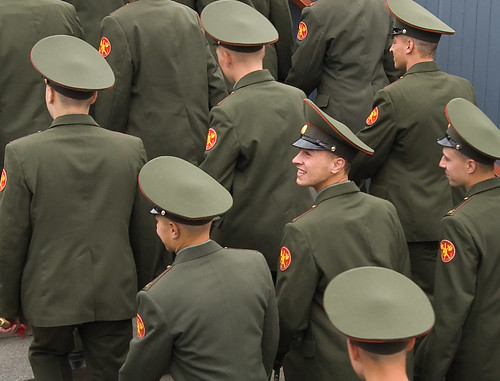
I was in Moscow recently for work, and first of all, I have to say that I was really impressed by the city. I love the new and old buildings, the funky subway stations and the eclectic mix of people. Quite frankly, I wasn’t quite sure what to expect, and as a result, was hesitant about bring my camera out. I needn’t have worried. I felt safer on the streets of Moscow than on the streets of San Francisco, and definitely safer on the Moscow metro than on the subway in Milan (probably due to the ever present military and police like the guys in the top photo).

I also brought my Nikon D200 up to have some fun and I learned 2 things: 1) Always have your camera with you and; 2) The shoulder bag doesn’t work for carrying heavy gear around all day.

I missed shots like this bottom photo because I didn’t have my D200 with me. I didn’t want to have my shoulder bag because I felt it was too easy a target for a grab and run theft. Other than worrying about having the bag ripped off, carrying the bag over one shoulder all day is a bit of a pain.

I had been thinking of getting camera backpack for a while but resisting because access to the gear is slower. This trip showed me not only would a backpack be useful in the outdoors, it would also solve 2 of my problems in cities: 1) It is not easily identifiable as a camera bag and not easy to grab since it is pretty much wrapped around you; and 2) My D200, 2 lenses and a flash are quite heavy and a backpack is much more comfortable to carry around all day. Better to have slow access to your camera than not have your camera with you at all. I ordered a Dakine Sequence photo backpack and should be getting it later this week.

Photos:
Top: Russian Soldiers Outside The Kremlin. Taken with a Nikon D200, 12-24mm
Middle: Train Whizzes By Stain Glass of Novoslobodskaya station. Taken with a Canon IXUS 850 IS
Bottom: Paris Hilton Sighted Outside St. Basil's Cathedral. Taken with a Canon IXUS 850 IS by Laura Koh.

Friday, July 13, 2007

RAW Rules!


It’s been about 3 months since I started shooting RAW, 6 weeks since I started using Abobe Lightroom. I’m now convinced that RAW is the way to go. Lightroom 1.1 has been instrumental in my conversion to RAW. It is a simple, powerful application that allows me to do almost everything I want – crop and straighten, adjust saturation, tones, curves, highlight and shadow recovery, noise reduction and sharpening. Best of all, it doesn’t harm the original RAW files, meaning it is non-destructive. It reminds me a lot of Apple’s brilliantly simple iPhoto, only it can do more, do it faster, and uses less memory. If you are not shooting RAW because it is too complicated, you should give Lightroom a try.

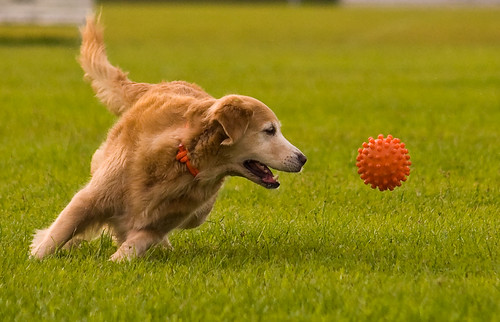
Top Photo: Don't You Just Love Golden Retreivers?
Taken with a Nikon D200, Sigma 50-150mm, shot in RAW and processed solely with Adobe Lightroom 1.1

Wednesday, June 20, 2007

RAW: Continued

I was a diehard JPEG shooter who began experimenting with RAW about a month ago. I was stumbling around for a while but I’m now happy to report that I’ve gotten some help and am settling into it.

Initially, I had no idea what I was doing wrong. I only knew that I was intensely frustrated. It seemed like too much work to shoot Raw and affirmed my choice to shoot Jpeg in the first place. Pro mountain bike photographer, Seb Rogers, pointed me in the right direction. What I needed was a better workflow.

That search led me to Adobe Lightroom, a program that promises to do it all – manage your photo library, edit, produce slideshows, print and web, all in one slick and polished looking app. And, I ordered Michael Clark’s Lightroom workflow e-Book to help me out.

Michael Clark is a professional adventure sports photographer, probably one of the best out there. I figured he would be a great person to learn this stuff from. His e-Book costs $29.95, and at only 96 pages long, it seems a bit pricy for such a small e-Book. This is not an instructional manual for Adobe Lightroom. You can get that for a lot less money elsewhere. This is a step-by-step guide that takes you through Michael’s own workflow, from how he sets up his Nikon D2x (D200) for Raw capture, moves files from camera to hard drive, importing to Lightroom, editing and developing the raw images in the Lightroom develop module and Photoshop CS2, to archiving. Michael shares some personal tips using Lightroom as well as lessons from the field.

My 30-day-trial with Adobe Lightroom is almost up. Lightroom is not yet the all-in-one photo app that I am looking for. I feel that version 1.0 of Lightroom is let down by overly simplistic sharpening and noise tools, but I hear that version 1.1 is on its way and has addressed those issues and more.

Stay tuned!

Friday, June 15, 2007

Confessions of a Gym Rat


My mum fell and broke her hip earlier this week. It wasn’t anything dramatic. She just lost her balance and fell to the floor. And now, she has a couple of titanium screws holding her hipbone together. Despite regular visits to the gym, she did not have functional strength to maintain her balance that may have prevented the fall.

My mum’s not that old. She’s in her 60’s. She visits the gym twice a week and works out mainly on the machines there. The problem with machines is that they can only exercise the muscle along one axis. That’s great for isolating and rehabilitating an injured muscle, but in real life, you can twist and turn and use your muscles in three dimensions.

Mum didn't have much chance to right her balance before she fell. Her stabilizer muscles were not developed in her gym routine. For example, the Leg Press machine she is so fond of is fine for building up the quads, but ignores the stabilizer muscles of the legs, and ignores the relationship between the legs, the core (muscles of the middle body), and the upper body. It’s the same for the other machines at most gyms.

I'm a gym rat, but if you’ve guessed I’m not a big fan of machines, you’re right. So if you’re wondering how else to get a workout in the gym, I can point you in the right direction. Core Performance, by Mark Verstegen, is a good place to start. The emphasis is on working out the body as a whole, and has elements of Pilates and Yoga. What’s also great about Core Performance is that the workout can be done with a simple home gym, or adapted for use while traveling.

If you’re an athlete and work out with weights for strength and power, another good reference is Dr. Michael Colgan’s: The New Power Program. One of Colgan’s premises is to avoid using machines for the reasons mentioned above, and prefer the use free weights and cables in order to recruit more muscle groups that are involved in stabilizing the weights. I’m a big fan of Dr. Colgan. His earlier work, Optimum Sports Nutrition, is a sports best seller, and it literally saved my life.

Despite my buff appearance in the photo on top, I'm not an expert. The authors of the recommended books are. Working out or training puts a lot of stress on muscle, joints, bones and the cardiovasular system. Please follow their advice at your own risk.

Photo by Stephanie Yeow