Adventure Nomad

Adventure Nomad
Showing posts with label Life. Show all posts

Wednesday, October 11, 2017

What's Up With Coconut Oil

Photo from Gizmodo: Please Calm Down: Coconut Oil is Fine
Should you stop taking Coconut Oil?  A recent article citing a 25-page study released by the American Heart Association say you should. The study itself doesn’t say much about Coconut Oil specifically, but rather looks at scientific studies from people who replaced saturated fat with other things in their diet, and how it relates to risk for Cardiovascular Disease.  The study states that if you replace saturated fat, like coconut oil, with refined carbohydrates, like white bread or pasta, you actually INCREASE your risk of cardiovascular disease.  Since I have replaced refined carbs, like bread, for breakfast, and substituting that for a tablespoonful of coconut oil in my coffee (aka, Bulletproof Coffee), this study was of interest to me.
Note that the study does not differentiate between ‘refined’ coconut oil, which is mainly used in countries like Malaysia, which is one of the reference studies quoted, versus ‘virgin’ coconut oil.
This article from Gizmodo takes a more balanced look at the subject. My own take is that since I am replacing refined carbs, like bread, for breakfast, and substituting that for a tablespoonful of coconut oil in my coffee (aka, Bulletproof Coffee), this is a healthier option.

Thursday, June 4, 2015

3 Basic Nutritional Supplements for Expeditions and Adventure Travel

The first rule of supplementation is - Real food first.  This means you should try to get your nutrition from fresh, natural, whole food.  Supplementation comes in to fill in potential nutrition gaps, which could happen if you are travelling and not quite sure of what food is available, or on expedition where fresh, whole food may not be available.

Yumm!  Liver Tablets, Probiotics and Fish Oil
I'll tell you what works for me, but I'm not a doctor, or nutrition expert, so please do your own research or seek medical advice before consuming any supplements.  Here are 3 basic, but key, nutritional supplements I take, whether at home or traveling to some adventure:

1.  Fish Oil
Fish Oil is a common term which refers to Omega-3 Fatty Acids, specifically EPA and DHA.

The body uses fish oil in many ways, including: Development and protection of the brain; cardiovascular protection (also 'thins' the blood by making it more 'slippery'); balances out Omega 3 and 6 ratios (our modern diet contains an unbalanced ratio of too much Omega 6); has anti-inflammatory properties; and helps protect against skin issues (psoriasis) and allergies.

The human body cannot make EPA or DHA, so you have to get it from your diet.  The best sources are cold water oily fish, like sardines, salmon and anchovies.  A rising problem with consuming these fish is that they may accumulate toxins like mercury dioxins and PCB.  If you are far from the sea, grass fed cattle is another source.

Fish oil in supplement form is usually molecularly distilled for purity, then recombined to ensure a consistently potent product.  To ensure I get my quota of Omega-3s when I travel, I take a single capsule of Now Foods Ultra Omega-3 daily, which provides me with 500mg of EPA and 250mg of DHA.

2. Probiotics
The human body is full of bacteria, both good and bad.  Probiotics are the 'good' or 'helpful' kind.

Researchers are still figuring out the many uses of probiotics.  They not only help the digestive system, but it is thought they also enhance immunity by shutting out bad bacteria. They also easy symptoms of Irritable Bowel Syndrome, Crohn's Disease, Eczema and other allergies.

Sources of probiotics include kefir, yogurt, miso, sauerkraut, kimchi and pickles.  Beneficial probiotics also exist in the soil which, with modern cleanliness, we no longer consume.

Because they are living foods, I supplement with 'shelf stable' probiotics that require no refrigeration and travel well.  I use Garden of Life Primal Defense which is a strong, broad spectrum probiotic supplement, which contains both colonizing and transient soil based probiotics which may be beneficial, but through modern cleanliness, we may no longer consume.

3. Desiccated Liver Tablets
Sometimes called "Nature's Multi-vitamin", the Desicatted Liver Tablets I take are made from pure, grass-fed beef liver that has been de-fatted, and then freeze dried.

Liver is a rich source of heme iron, which is a great blood builder.  Exactly what is needed on a trip to high altitude.  It is also a rich source of amino acids, minerals, B-vitamins and Cytochrome P-450.  It may also extend endurance as demonstrated in the following experiment:


Proc Soc Exp Biol Med. 1951 Jul;77(3):488-91
'Dr. B. H. Ershoff took three groups of rats and fed them controlled diets for a twelve week period. Group one ate a basic diet fortified with vitamins and minerals. Group two ate as much as they wanted of the same diet plus B vitamins and brewer's yeast. Group three ate the basic diet but had 10% desiccated liver added to their rations.
Then the doctor placed the rats one by one into a drum of water, out of which they could not climb, it was either swim or drown. The group one rats swam an average of 13.2 minutes. Group two, an average of 13.4 minutes. Group three, however, were still swimming at the end of two hours.'

I take 2 Universal Nutrition Uni-Liver Tablets each morning.  High on Mt. Everest when my stomach could not function well, it was one of two supplements that I would swallow with my instant noodles (the other was fish oil).  I'm not sure if that was enough to get the endurance boost, but it was worth a few grams of protein and enough for the summit.
I order these supplements from iherb.com.  For international orders, they are hard to beat for selection, price and shipping.  Get $10 off your first order with my discount code KOH756.

Sources: Web MD, Michael Colgan, Robb Wolf, Chris Kresser, Dave Drapper

Monday, April 27, 2015

Nepal In My Thoughts and Prayers

A photo posted by Ken Koh (@adventurenomad) on

I've been filled with a kind of helpless frustration watching the aftermath of the earthquake in Nepal.  I cant sleep and can't get the situation in Nepal out of my mind.  I just learned that a friend has lost his home.  I guess what is so disturbing is that for the past 30 years that I've been coming to Nepal, it has remained largely unchanged: The same buildings, temples, narrow streets, etc.  Kathmandu and the rest of Nepal have had a timeless feel.  While the rest of the world charges on towards the 22nd century, Nepal struggles to keep up with the 21st century.... and that was its appeal.  Returning each time to Nepal (well, at least outside of Kathmandu) has always made me feel at peace... grounded... my escape from an all too modern life.  The next time I return to Nepal, will it have changed?  Sure, ancient buildings will need to be repaired or replaced by modern structures, but its the heart of its people that will persevere, and their resilience which will see them through these difficult times.

If you want to help out, don't pack your bags unless you have a specific skill that is needed there, otherwise you will just be another person to feed and shelter.  It's not a bad idea to donate to an organisation like the Red Cross which can distribute funds to where it is needed most.  Another way to help out is to not shy away from Nepal when it has recovered.  Tourist dollars will be most needed, and the mountains remain a stunning landscape, and unforgiving beauty.

Friday, December 12, 2014

#blackandwhitechallenge


While out-of-action with a broken collarbone, I thought I'd go through some of my favorite images and rework them in black and white.

#blackandwhitechallenge Day 1/5. Taken in the Gobi Desert during a 250km ultra-marathon called the Gobi March in 2005. Our team of 3 was hot on the heels of Team USA, but we would eventually lose to them, finishing 2nd in a very small field. It was my job to be the team photographer, so the guys offered to lighten my load in order for me to run ahead, snap a few shots, and then run to catch up. - Taken with a Pentax Optio 43WR, 95mm (35mm equiv), f/9.3, 1/200, ISO50. 
#blackandwhitechallenge Day 2/5.  Joanne descending into the mist on the Via Feratta, Mt. Kinabalu, Borneo Malaysia. Jo is one of 5 amazing women who climbed Mt. Everest in 2009. At the invitation of Mountain Torq, we were allowed to climb freely on the Kinabalu Massif without the need of guides. Taken with a Panasonic Lumix LX3, 24mm equiv, f/4.0, 1/50, ISO80.

#blackandwhitechallenge Day 3/5. This amazing woman is my wife, Laura, during the inaugural Tour de Timor Mountain Bike Race in 2009. We were rookies and did not really know what we were doing. It was the first day of the 5-Day stage race, she finished dead last, and the medics sent her to the hospital in Bacau for what looked like heat exhaustion. She started the next day though, and finished the race strong. That was the start of her mountain bike career. Today, at nearly 50-years-old, she is Singapore's current XC Mountain Bike Champion. - Taken with a Panasonic Lumix LX3, 24mm equiv., f/4.5, 1/800, ISO80. 
#blackandwhitechallenge Day 4/5. Megagrit! - Pauline cranking out some Wall Ball Sit Ups with a broken foot at Crossfit Singapore. I'm inspired as I begin my own rehab for a broken collarbone. Taken with a Nikon D7000, 12-24mm at 12mm, f/4, 1/60, ISO1600.
#blackandwhitechallenge Day 5/5. Summit, Mt. Chola (6168m), China. This is one of my favourite shots in color, but the b&w contrast and vignette adds some drama to the dawn sky.  Taken with a Panasonic LX3 at 24mm equiv, f/2.8, 1/500, ISO80

Monday, December 8, 2014

Yes! I am Ironman!!!

I broke my collarbone into 3 pieces about three weeks ago.  It was a rock-climbing accident.  I was learning to ride a motorbike so that I could access a rock-climbing crag in Thailand, fell down and broke my collarbone... so to ease my battered ego, I'm chalking it up as a climbing accident;)
My Collarbone Broken in 3 Pieces :( Meh
I had surgery done about 2 weeks back and am on the road to recovery.  The procedure was pretty high-tech.  I had a stainless steel (recommended by the surgeon over titanium) plate inserted under my collarbone by keyhole surgery.  The plate was bent to conform to the shape of my collarbone, and inserted underneath so that I won't feel the plate when I'm carrying a backpack.
Stainless Steel Plate inserted under Collarbone
I had a couple of projects planned out, but that will have to wait til I'm stronger.  I've not been very active on Instagram, but I'm getting bored and looking for things to do, so I'm reviving my Instagram account and learning about hash tags.  Ho hum...

Monday, January 13, 2014

The North Face Singapore Speaker Series 22 Jan 2014

If you're in Singapore next Wednesday night, 22nd January 2014 at 7:30pm with an hour or so to spare, and want to hear my wife, Laura and I, talk for a bit, please sign up at tnfmarketing@outdoor-venture.com and get a free gift from The North Face as well!

Monday, December 2, 2013

A Dog Named SanDeE

SanDeE with my wife, Laura, during happier times
Cancer sucks.  It doesn't matter if it happens to a human or a dog.  It not only sneaks up and robs one of life, it does it in a way that causes much pain and suffering.  And so it was with SanDeE...
Taking a break out on the trail
SanDeE was named for the color of her coat, but spelled after Sarah Jessica Parker's character in the 1991 movie, L.A. Story (Big S, little a, little n, big D...).  When she was a young pup, she would fall down a lot.  She fell off a ledge at the back of our house (which gave us a huge scare because probably a 10' (3m) drop) only climb back up shakily.  She also fell into our fish pond, and that's when we learned that Golden Retrievers are natural swimmers.  We suspected hip dysplasia,, and a visit to the vet confirmed this.  A couple of expensive surgeries failed to fix the problem, and on our regular runs, she would lag behind, eventually dropping out of sight, but always appearing a few minutes later, soldiering on and wearing her silly, happy grin.

We had bought SanDeE from a pet store who had obtained SanDeE from a local breeder.  When we informed them about SanDeE's hip dysplasia, they offered to 'replace' the puppy.  But with SanDeE's fate uncertain, giving her up was not an option.
Out for our evening walkie with the doggies
The years passed.  She loved to swim, and swam almost everyday.  In the fish pond, when we had a pond.  Then in a pool when we moved and had a pool.  She never really could walk for long, and eventually we settled on a routine.  When she'd had enough, she'd just stay put and munch on some flowers, and we would come around to pick her up on the way back.
It's SWIMMING TIME!!!
Other than the hip dysplasia, SanDeE had the temperament and character of a perfect Golden Retriever.  She was brave, gentle, loved children and other dogs, and would comfort anyone in distress.

When we brought SanDeE in to see the vet, we had thought she had some sort of indigestion.  But no, it was cancer and the cancer was too advanced to treat and the vet advised us to put SanDeE to sleep.  It was a decision we were not prepared to make, and so we brought SanDeE home with a few days worth of painkillers.  When those ran out, we brought SanDeE back in and the vet was happily surprised to see her looking so well.  This time, we brought back two weeks worth of painkillers.
Santa and her reindeer.  Hehe... Doggies will do anything for their masters!
SanDeE lived for two more weeks beyond the initial diagnosis.  The painkillers helped, and in those two weeks, she had only four bad days.  Two of those bad days were right at the end.  She couldn't eat, not even her painkillers, couldn't move, and the last night she coughed up a lot of blood.  We spent her last day doing he favorite thing in the whole world: Car rides!  Each time we drove somewhere, we would open up the back of the SUV for her to experience something new.  New sights, new sounds, new smells.  She was interested, but we could see that she was in pain.

And when it was time to end her suffering, we kept SanDeE in her happiest of places, the back of our SUV while the vet did her work.  I locked gaze with SanDeE until she closed her eyes for the last time.
SanDeE, world's sweetest doggie, born 18 January 2003, went to doggie heaven 21 October 2013

Thursday, April 25, 2013

Bullet Proof Your Coffee. It's AMAZEBALLS!!!

Taken with an iPhone 4s, edited on Snapseed.

How do you bulletproof your coffee?  Well, the exact recipe from the person who coined the term is here.  Basically, it's taking a double expresso, add an equal amount of water, add two tablespoons of unsalted butter, and/or a healthy portion of coconut oil, and then blending the concoction until you get a creamy head of foam, much like a latte.

Dave Asprey is the man behind the bulletproof diet, which is basically built on the 'Paleo' or 'Caveman' diet.  On a trip to Tibet, he tried Yak Butter Tea, which is what the Tibetans and Sherpas drink in the mornings for energy.  If you've never tried it, it's more like soup than tea, and is most certainly an acquired taste.  Instead of putting butter in tea, he used coffee, and the taste is much more palatable.

Fresh roasted coffee has natural oils, which gives good coffee its rich flavor and texture.  So the added butter (it has to be unsalted) just adds a creamy 'feel' to the coffee.  Adding coconut oil does change the flavor the coffee, and it may not be to everyone's taste.

Why bulletproof your coffee?  Well, Asprey says it can promote brain function, memory, and energy levels.  Asprey's idea is that you have this cup of coffee for breakfast, and nothing else, which kind of trains the body to burn fat for fuel.  If you can do that, Asprey says you'll lose weight, and it leaves you feeling lean, focused and energized.  It's an interesting idea, and I'm attempting to move towards it... slowly.  Although I've bulletproofed my morning cup of coffee (and enjoy it that way), I still eat my bacon, eggs, and a banana with it!

Saturday, March 23, 2013

Lick The Rainbow Popsicle

by Postitguy
A friend posted this on her Facebook wall.  I've read it again and again, and it's too good to not share.

It's by the Postitguy - someone who leaves these yellow sticky notes in public places all over Singapore, left to their fate, to be found and perhaps enjoyed.  Postitguy has a blog: thingsweforget, where this and other gems of wisdom can be found and enjoyed.

This is how I want to live my life!  Thank you Postitguy :)

Update: Postitguy has another blog: The Plan Today, which is where the above note can be found.

Sunday, December 30, 2012

Great Deal on The Panasonic LX7

I wrote not too long ago about the Panasonic Lumix LX7, and I've been waiting to buy mine.  Well, it looks like now is the best time to get one.  For whatever reason, the price has taken a huge drop.  Perhaps the market has decided that it prefers the larger sensor of the Sony RX100 and the LX7s are overstocked.  Whatever the reason is, I'm taking advantage and getting one now.

Get your Panasonic LUMIX LX7 at US$299 from Amazon now!


* If you're in Singapore (like me), street price for the LX7 is S$599.  There's a rebate offer for a free battery and a SG$50 NTUC voucher from authorized Lumix dealers until January 13th.  Not quite as good as the US deal, but it works for me ;)

Wednesday, May 2, 2012

It's Not All About Flipping Tires

There's a lot of Crossfit bashing going on, most of it directed at the elitist cult that Crossfit is perceived to have grown into.  I'm not going into that.  For me, it's about the training method and principles.  Forgive me, I'm a Crossfit Zealot.  Nevertheless, I shall do my best to break it down into what I see as the good and the bad, and how I've adapted it to enhance the enjoyment and competitiveness of my sport, activities and life.

Crossfit is a community developed, empirically driven, clinically tested strength and conditioning program.  I've been using Crossfit as my primary strength and conditioning training for more than two years, training both with an affiliate (that would be a gym with instructors), as well as on my own.  Prior to that, I used a conventional bodybuilding-based gym training approach.
Mmm... Prowlers... My favorite workout!  Photo © Laura Liong
Constantly Varied
You don't get to choose your workout.  In essence, your Crossfit workout is 'randomly' selected out of a hopper and could range from heavy weightlifting, to fast sprints with gymnastic movements, and could last from a few minutes to over an hour. 

The Good:
We tend to choose to do what we like to do and avoid doing what we don't like to do.  This leads us down the dangerous path of training our strengths and avoiding our weaknesses.  A varied, randomized workout avoids this.  It's training for any and all contingencies, the unknown and unknowable.  This type of training works well for the person who needs to be a generalist: Soldiers, firefighters, law enforcement officers, and some athletes (like mountain climbers, rugby players, mixed martial arts fighters). 

The Bad:
If you are a specialist, for example an athlete involved in a sport requiring high skill, in a known environment for a fixed time (like an indoor track cyclist), then you may need more than the generalized training that a pure Crossfit program provides.  If you have a coach who can identify your strengths and weaknesses, you would benefit more by targeting your specific weaknesses, than from a generalized program.

My Take:
These days, I train Crossfit on my own, usually twice a week.  I choose my workouts based on the longer term goals of my training program, a race or event.  I'm at risk of falling into the trap of training my strengths, but it's a compromise given the time I have.
A broken foot is no reason not to workout.
Functional Movements
This is the current buzz word at fitness centers worldwide.  What does it mean?  Functional movements are how your body naturally does real-life work, like lifting things.  Your body knows to move that way because the movements are naturally efficient, powerful and safe.  For example, lifting a heavy sack of potatoes efficiently to your shoulder would be a movement called a 'Clean'.  The clean is naturally the most powerful, and hence efficient, way to lift a load from the ground up to shoulders.  Executed at a high skill level, it is part of an Olympic lifting movement. Examples of other functional movements are squats, running, and pull ups.  Functional movements are proven to illicit a high neuroendocrine response which in turn does a whole lot of good things to your body, like increasing bone density and human growth hormone.

The Good:
Form follows function, and unlike some other workout programs that focus purely on cosmetics, Crossfit uses functional movements almost exclusively because their goal is making you stronger, faster and more durable.  Most workouts can be done with simple equipment: a barbell with weights, medicine ball, kettlebell, jump rope, pull-up bar and some space to run. 

The Bad:
Although natural, some complex functional movement patterns need to be taught, because our bodies haven't learned the coordination and sequencing needed to do those movements.  For example, the Clean.  Crossfit is one of the few training programs that still teaches the Olympic lifts - The Snatch and The Clean and Jerk.  Both of which are excellent power builders that induce a profound neuroendocrine response.

My Take:
I haven't stepped into a conventional gym in years.  Years of spending time on machines doing isolation movements like leg extensions and leg curls haven't done much for me.  The proof is not in looking at yourself in the mirror, it's in living your life, now and in the future.  If you lose the ability to squat (a functional movement), you lose the ability to walk up stairs or lift yourself up off the ground.  In short, you lose the ability to live life independently.  No amount of leg extensions or leg curls will give it back to you. 
Someone to Watch Over Me.  Supervision plus motivation: another reason to workout at an affiliate.
High Intensity
The heart of the Crossfit program is that the workout, ie. the constantly varied, functional movements, is executed at a high intensity.  Why?
To answer that question, we have to get scientific:

(force x distance / time) = Power

That is the definition of power.  The less time it takes to do a given amount of work, the more power.  In simple terms, Power = Intensity.  The more intense the workout, the more power you are putting out.  Training for more power will improve just about any sport.

The Good:
There is increasing evidence that shorter, high intensity workouts are far more beneficial than long, slow workouts.  They are also very time efficient.

The Bad:
High intensity workouts hurt.  A lot of beginners are turned off by this sort of training.  The loss of form as fatigue sets in is one of the bones of contention that Crossfit objectors raise.  Functional movements are inherently safe, however, it's best to work out at an affiliate where others can watch and correct your form.

My Take:
High intensity training works. However, it is strong medicine and I have to be careful about doing too much, which can quickly lead to overtraining.  I scale down both the load (weight) and number of sets as required.  If I feel the need, I'll even substitute a functional strength training session instead of Crossfit by removing the intensity.

Bottom Line:
It's not for everyone.  Check it out and decide for yourself.  Learn more at Crossfit.com

If you are in Singapore, try one of the affiliates:
Crossfit Singapore; or
Reebok Crossfit Enduro

Saturday, December 31, 2011

A Life Less Ordinary


I once led a normal life.   Some would call it ordinary.  For a while, it was what I wanted... and then it wasn't.  So I quit my job as an airline pilot, sold the house, sold the sports car, and got out of the ratrace.  This was four years ago.  My life is full and I haven't looked back. 

How can I help make 2012 a year where you can live beyond the ordinary?  First of, don't quit your job unless you have a sound financial plan.  Here are some ideas I've picked up over the years:

Stretch Yourself
You've got to start somewhere.  What are you doing for your next vacation?  Maybe it's time to get a little dirty, sweat a little and challenge yourself.  Maybe set a goal for yourself.  Instead of sitting on a beach in Bali, maybe you can trek in Nepal.  Do something different.  If you're a runner, maybe buy a mountain bike and learn the skills to ride offroad confidently.  Stretch yourself both mentally as well as physically.

Approaching the Summit of Mt. Chola (6168m) in Sichuan, China.
You Got to Pay Your Dues
Every adventurer starts out with smaller challenges, building experience with small mistakes.  Want to climb a big mountain?  First learn the skills: rock-climbing, ice-climbing, snow craft, rope work, etc. Then practice the skills by taking small, weekend trips out into the mountains.  Accumulate experience: find out what works, what doesn't.  Finally, train physically to accomplish your goals.

Trekking the Annapurna Circuit, Nepal

Make a Plan, Write it Down
For me, I can only plan it if I can write it down, and clearly see the steps needed to get there.  I have a big whiteboard divided into 12 blocks for the coming 12 months.  I pen in the goal and then pen in the various things I need to do to get there (buying equipment, training, etc), refining it as I go along.  For me, planning for something that's going to take place in, say five years, would not be a plan at all.  It would be a dream.  I need to write it down which solidifies it, makes it real, as if to say, "this is going to happen!".
Kayaking the Pahang River from Source to Sea, Malaysia.
Sponge up the Right Information
Read everything you can about what you want to do.  This is part of preparation.  Libraries and the internet are a wealth of information.  Sometimes, there's conflicting information.  If this is the case, find a guru - someone who's ideas and philosophy resonate with yours, and follow them.  Google them and read everything they have written, email them, if necessary, to find out their latest ideas, or to get some tips.

You are not the same person you were yesterday as the person you can be tomorrow.

Have a great 2012!


Friday, November 11, 2011

Top 4 Travel Must-Haves To Keep You Healthy

These are my top 4 travel must-haves.  They have multiple uses and purposes and can often replace more than one item in your travel kit.  These are what I use at home and take with me everywhere I go to keep me healthy. 

Silver Sol

I've gone from being a skeptic to a convert (see my original blog post here).  Silver Sol is a broad spectrum antimicrobial.  What that means is that is kills germs, bacteria and fungus.  Think about it.  That means possible protection from SARS, malaria, dengue, Hepatitis C, AIDS, influenza, diarrhea or dysentery, athlete's foot and a whole host of other fungal, viral or bacterial infections you could get (the full list is available here).
I use Silver Biotics from American Biotech.  That's the liquid stuff.  It's not effective if you use it topically for issues like athlete's foot.  For that, you'll need Silver Sol gel, which is more concentrated and stays on your skin longer.  For external problems, I just use tea tree oil, which is the 3rd item on this list.
Personally, I just buy the liquid Silver Sol, transfer it into a small spray bottle and keep it in my toiletry case.  I put 4 squirts in my mouth (about a teaspoon) after I brush my teeth (twice a day).
Silver Sol has replaced the anti-biotics, alchohol swabs, antiseptic cream and diarrhea medication from my first aid kit.
Dr. Bronner's Peppermint Soap

Dr. Bronner's Castille Soaps have been around for ages.  They come in a solid soap bar, or liquid in a bottle, and come in a variety of scented flavors.  I buy the peppermint liquid soap and transfer it into a smaller, leak-proof, plastic bottle.

They are organic and natural and hence they are great when used outdoors (with the possible exception in bear country because of the scent in the soaps).  I use it as soap, shampoo, toothpaste, laundry detergent, dishwashing liquid and deoderant.  Here's the official Dr. Bronner's list of what you can do with it.

Tea Tree Oil

Tea Tree Oil is an essential oils from the Australian plant Melaleuca alternifolia.  It is often used for its anti-fungal and anti-septic properties.  It is used externally, and should always be diluted.  It should never be consumed, although small amounts used in toothpaste and mouthwash is ok.  Be careful using this stuff around pets as it can be toxic to cats and small dogs.

These days, I'm biking a lot, and in the humid conditions here, I'm prone to fungal infections like athlete's foot.  Tea Tree Oil can be mixed with Silver Sol for a potent anti-fungal treatment.  I haven't tried this yet, but it's on my list.  I mix a few drops of tea tree oil with my Dr. Bronner's soap in a small plastic bottle and use it when I shower.  It's light enough that I can still use it as toothpaste if I need to.

Gloves in a Bottle

Gloves in a Bottle is not a moisturizer.  It's a shielding lotion that bonds with the outer layer of your skin.  Having said that, for me, it works like a moisturizer on steroids.  It seals in moisture, and helps to protect minor scrapes, abrasions and burns.

I was turned on to this stuff after my Aconcagua climb, where my skin cracked and split at the nails.  This was painful and made it hard to work on the mountain with my hands.  On Everest, my Sherpa and I used this stuff successfully with no problems during our two month long expedition.  I use it on my face, body and scalp; and it can also be used on lips as well.  My wife used it in lieu of a moisturizer on her face when she biked from Lhasa to Kathmandu earlier this year.  Despite the harsh, dry conditions, she said her skin never felt better!

Most of these items can also be purchased at iherb.com.  Iherb is pretty good if you are shipping overseas.  I'm not sure what the prices are, but it may be worth comparing.  Also, if you are new to iherb, use this discount code to get $10 off you first purchase: KOH756

Thursday, August 4, 2011

Vision 2030 Singapore

Vision 2030 is an initiative by the government of Singapore to explore the opportunities in sport to best contribute to the future development of the people, communities and country.


There are seven sub-committees or 'areas of discussion':
- Balance to the Rhythm of an Urban Lifestyle;
- Future Ready;
- Futurescape;
- Generation Z;
- Organising for Success;
- Silver Generation; and
- Spirit of Singapore.

I've been asked to sit on the Futurescape Sub-Committee, which explores creative and innovative use of space for sport in the future. I feel honored to be one of only two athletes on the panel, and I feel lucky that adventure sports has a voice in the future of Singapore sports.

Take a look at the Vision 2030 website, and if you have any suggestions, click on one of the 7 areas of discussion to leave your feedback, or drop me a comment below.

Thanks.

Saturday, July 16, 2011

The Green Corridor

The Green Corridor is the nickname given to the disused railway line in Singapore when the Malaysia-Singapore KTM trains ceased operations on July 1 2011.  In Singapore, there's great potential for this corridor of land which runs from the North of Singapore (Woodlands) to the South (Tanjong Pagar).  


Here's a quick look at The Green Corridor from Holland Road to Bukit Timah Road

In the South of Singapore, this corridor runs through a highly urbanized area. Like other 'Rails to Trails' efforts, I'm hoping that Singapore will retain this corridor of land for 'active transportation' use - an alternative means of transport for commuters to walk or bike.  Ideally (for me anyway), this green corridor would extend from the Bukit Timah Nature Reserve all the way to Tanjong Pagar.  This would give opportunity for people to bike to work downtown, or to the Nature Reserve in Bukit Timah.

The government of Singapore is looking for ideas with what to do with this land.  Support The Nature Society of Singapore's effort to keep The Green Corridor.

Friday, March 25, 2011

The Cult of CrossFit

Pulling the sled around the block at CrossFit Singapore.  Photo by Laura Liong
Tucked away in a Kallang industrial estate amidst motorcycle workshops is a small, gritty gym.  It's called Crossfit Singapore and it's run by 32-year-old Kevin Lim, or 'Coach' as he is called by his 70+ members.  The gym has been running for two years, and its members pride themselves on having the most intense workout of any commercially available program.  "Your workout is my warmup", they like to say.  Indeed, having followed the program for just over three weeks, I can attest to it's intensity and it's effectiveness.
Coach Kevin cranking out some pull ups.  Photo by Laura Liong
Workouts range from gymnastic movements, olympic weightlifting and sprinting.  Among the more unusual tools used include sleds to pull loads around the block and monster truck tires.  Workouts are constantly varied, so the body doesn't get used to them, but they are also very short.  The longest workout is about 25 minutes, and a typical workout lasts around 15 minutes.  The key is the intensity, and Crossfit can really ramp it up!  For those 15 minutes, your heart will be working at near maximum capacity!  It's an intense blend of strength training and aerobic conditioning, and is definitely not for the faint of heart!
CrossFit Culture.  Photo by Laura Liong
CrossFit has its roots in founder Greg Glassman's garage about 40 years ago.  It has evolved to become the world's fastest growing fitness movement with a culture of its own.  Its gritty, no frills, take-no-prisoners style is not for everyone.  About 80% of new participants drop out.  Practitioners who stick with the program include not only elite armed forces all over the world, but also grandmothers looking for a way to boost functional strength and have a more active and productive life.

How can this be?  Can grandmothers really participate in workouts that "are universally regarded as being the toughest workouts in every athlete's experience."?  Coach Glassman says that "the needs of our grandparents and soldiers differ in degree, not kind.”  Those needs would be to build a broad and general functional competence, in such movements as squatting, picking things up off the ground, putting things overhead, pulling ourselves up, running, and jumping.  The key to the all-inclusive nature of CrossFit's training program is the ability to scale, or tune the workload to match each individual athlete's abilities.

Richard performing the Snatch, an Olympic weightlifting movement practiced in CrossFit.  Photo by Laura Liong
How does one get started in CrossFit?  The best way is to start is with an affiliate gym to learn the movements.  If there isn't an affiliate gym nearby, go to CrossFit.com.  The WODs or Workouts of the Day are posted online.  Instructions and videos are also available on the website to help learn the movements.  Most importantly, take the first few workouts easy.  Scale down the loads if you need to, and take the time to learn the mechanics of the movement.

One thing is for sure, CrossFit has changed the way I train.  Permanently.


CrossFit Defined:
CrossFit is a strength and conditioning system built on constantly varied functional movements executed at high intensity.  The aim of CrossFit is to develop total fitness as defined by these ten physical skills: cardiovascular/respiratory endurance, stamina, strength, flexibility, power, coordination, agility, balance, and accuracy. 

Monday, October 4, 2010

Everest: Nutritional Supplements

I wrote this article because there is so little information in the way of high-altitude mountaineering and nutritional supplements.  I did some research and I hope others will find this information useful.  Here's what I'll be fortifying my diet with when I take on the world's highest mountain next Spring. 

Nutritional supplements have become a way of life in our modern world.  At this time, the argument isn't so much WHETHER you should supplement, but WHAT you should supplement your diet with.

Climbing Mt. Everest has it's own challenges nutritionally.  I'll be on the Everest expedition for about 2 months next Spring, and training hard for about 6 months til then, and I've determined that to keep myself healthy, I've got to supplement my diet with some nutrients.

I repack my supplements into small one-a-day ziplock bags, and take 1/2 in the morning with breakfast and the rest with dinner.  Here's what's in them:

Morning* 
1 AOR Ortho Core Multivitamin
1 Controlled Labs Orange Triad Multi
1 Now Vitamin C 1000mg, Buffered, Time Released, with Bioflavanoids
1 AOR Mito Charger
1 Beverly International Ultra 40 Liver Tablet

Evening*
1 AOR Ortho Core Multivitamin
1 Controlled Labs Orange Triad Multi
1 Now Vitamin C 1000mg, Buffered, Time Released, with Bioflavanoids
1 AOR Ortho Bone Calcium Supplement
1 Controlled Labs Oximega Fish Oil Capsule

* Amazon links are provided for your information.  I have not checked out the prices.  Personally, I buy my stuff from bodybuilding.com and iHerb.com (use referral code KOH756 and get $5 off your order from iHerb.com) or TSW.com.sg.
In addition, there are certain 'high altitude' supplements I take when I climb, and I start taking these about 2 weeks prior to when I start a high altitude climb:

Morning
1 GNC Ginkgo Biloba Plus Siberian Ginseng
2 First Endurance Optygen HP Capsules

Evening
1 GNC Triple Garlic
1 Digestive Enzyme


Why I take what I take:
The AOR Ortho Core and Controlled Labs Orange Triad are both very good multivitamin supplements.  Each has something that the other one doesn't. Orange Triad has joint aids like Glucosamine, Chondroitin, MSM, and Hyaluric Acid; Ortho Core has N-Acetyl Cysteine (NAC), a precursor to Glutathione, which in addition to being a very powerful antioxidant, may also help clear the lungs of excess mucous.  I hedge my bets and take a little of each.  A standard dose is 6 per day, but at my bodyweight of only 63.5kg (140lbs), I figure 4 per day will do*.  

*Update Feb 2011
Ok, this isn't working out for me.  Since changing over to the new multis, I haven't been feeling as vital.  I think I need to switch back to using a multi at full dose, but I might do something else, like NOW Adam.


I take my fish oil supplement in the evening to prevent 'fish' burps in the day, but also because I believe the slower burning fat in the oil helps keep me warm at night.  Multivitamin supplements, together with a Fish Oil supplement, are what I recommend everyone take, regardless of whether you are climbing Mt. Everest or not!

Vitamin C and Calcium are usually never in large enough quantities in a multi.  I've chosen to add 2000mg of vitamin C a day.  Some are going to say it is too much.  It's a personal decision.  I've tried reducing the amount, but each time I do, my old asthma creeps back in.  Through trial and error, I've found out that the minimum I need to keep my asthma (and other allergies) at bay is 2000mg daily.


The Ortho Bone Calcium supplement is very interesting.  Although there is only 100mg of elemental calcium per capsule in this supplement, it comes in the only form of calcium shown to regrow bone (MCHC, or the Hydroxyapatite form which comes from bovine bone tissue).  The other forms (such as citrate, carbonate, etc) have only been shown to slow down bone loss.

The liver tablet is an 'old school' bodybuilding standby.  Among other things, they are known to increase endurance.  I take one a day to help my body build blood (each tablet provides about 2mg of heme iron), as to well as add in a few BCAA amino acids.

AOR Mito Charger is a new player on the market and brings together 3 useful micronutrients for keeping the mitochondria, or the body's energy production systems, healthy: Coenzyme Q10, R+ Alpha Lipoic Acid and Acetyl-L-Carnitine.  Currently, I'm taking these in 3 separate pills.  This one product brings it together for me in one pill, and at less cost. 


Gingko Biloba, Siberian Ginseng (Eleuthero), Garlic and the ingredients in Optygen HP (Rhodiola and Cordyceps) are known to help acclimatize and perform in high altitude.  I only take these supplements just prior to and during a climb, and they are not part of my daily supplement pack.
 
One of the challenges of high altitude climbing is trying to swallow pills, especially if you are nauseous.  I try to limit the number and size of the pills I have to swallow.   And because altitude can also mess around with your ability to digest food, I take a digestive enzyme with dinner, which is usually my largest meal for the day.

Thursday, May 20, 2010

Training to Climb Mt. Everest

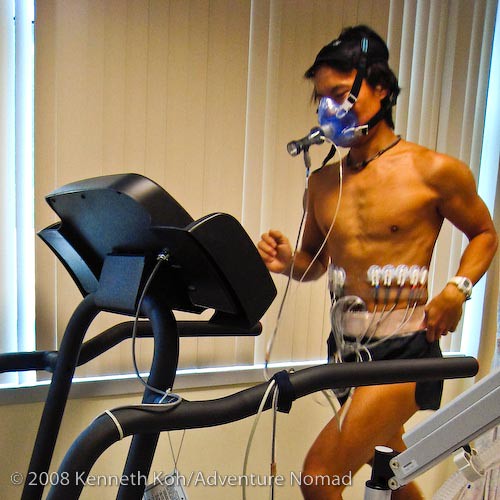
VO2 Max testing in 2008.  I did another one at the start of the year before I began training for Everest.

There's surprisingly little specific information available for training to climb the big Himalayan peaks, or high altitude mountains.  Searching the web yielded Ed Viesturs's training program.  I tried Ed's program of 4-days-on, 1-day-off (which means less than one day of rest in a typical training week), but I was pretty whacked out by the 4th day.  And then the 1-day-off wasn't enough recovery time, so I couldn't get the intensity up during the next 4-day-on cycle.  I've now settled into a 3-day-on, 1-day off cycle, and this has been working well for me.

I read as many books as I could find on the subject, including: Mark Twight's Extreme Alpinism, The Outdoor Athlete from Human Kinetics, and Clyde Soles's Climbing: Training for Peak Performance.  The one book which stands out, and that I continue to refer to, is Twight's Extreme Alpinism.  Although slightly outdated, it still contains much relevant information, and the principles of training, nutrition and equipment can still be applied.  Twight now owns and runs Gym Jones, a successful, if somewhat controversial gym, that trained the cast and crew of the movie '300'. Twight's Gym Jones website offers some of his updated philosophies on training and nutrition.

Twight and I seem to have read the same books.  Twight's nutrition advice agrees with Dr. Michael Colgan's groundbreaking 1993 book Optimum Sports Nutrition; and Colgan's strength training advice from The New Power Program: Protocols for Maximum Strength seems in line with Twight's (Twight now uses Crossfit training elements in his strength training protocol which I've also employed in mine).  Twight's advice for cardiovascular training is a departure from the norm in that he advocates intensive (interval) training before extensive (long endurance) in the macro training cycle.  If that sounds complicated, it is.  Go read the book ;o)

Core training.  Photo © Laura Liong

It's about a year til my Everest climb, and from Experience, I know I'll get burned out if I try to plan out a macro training program that allows me to achieve peak fitness once in a whole year.  So I've broken it down into two roughly 6-month long programs.  I plan to peak my fitness to climb Mt. Chola, China (6168m) in August, take a short break, and the train up again to peak fitness for the Mt. Everest climb in the Spring of 2011.