Adventure Nomad

Adventure Nomad
Showing posts with label Everest. Show all posts

Thursday, June 4, 2015

3 Basic Nutritional Supplements for Expeditions and Adventure Travel

The first rule of supplementation is - Real food first.  This means you should try to get your nutrition from fresh, natural, whole food.  Supplementation comes in to fill in potential nutrition gaps, which could happen if you are travelling and not quite sure of what food is available, or on expedition where fresh, whole food may not be available.

Yumm!  Liver Tablets, Probiotics and Fish Oil
I'll tell you what works for me, but I'm not a doctor, or nutrition expert, so please do your own research or seek medical advice before consuming any supplements.  Here are 3 basic, but key, nutritional supplements I take, whether at home or traveling to some adventure:

1.  Fish Oil
Fish Oil is a common term which refers to Omega-3 Fatty Acids, specifically EPA and DHA.

The body uses fish oil in many ways, including: Development and protection of the brain; cardiovascular protection (also 'thins' the blood by making it more 'slippery'); balances out Omega 3 and 6 ratios (our modern diet contains an unbalanced ratio of too much Omega 6); has anti-inflammatory properties; and helps protect against skin issues (psoriasis) and allergies.

The human body cannot make EPA or DHA, so you have to get it from your diet.  The best sources are cold water oily fish, like sardines, salmon and anchovies.  A rising problem with consuming these fish is that they may accumulate toxins like mercury dioxins and PCB.  If you are far from the sea, grass fed cattle is another source.

Fish oil in supplement form is usually molecularly distilled for purity, then recombined to ensure a consistently potent product.  To ensure I get my quota of Omega-3s when I travel, I take a single capsule of Now Foods Ultra Omega-3 daily, which provides me with 500mg of EPA and 250mg of DHA.

2. Probiotics
The human body is full of bacteria, both good and bad.  Probiotics are the 'good' or 'helpful' kind.

Researchers are still figuring out the many uses of probiotics.  They not only help the digestive system, but it is thought they also enhance immunity by shutting out bad bacteria. They also easy symptoms of Irritable Bowel Syndrome, Crohn's Disease, Eczema and other allergies.

Sources of probiotics include kefir, yogurt, miso, sauerkraut, kimchi and pickles.  Beneficial probiotics also exist in the soil which, with modern cleanliness, we no longer consume.

Because they are living foods, I supplement with 'shelf stable' probiotics that require no refrigeration and travel well.  I use Garden of Life Primal Defense which is a strong, broad spectrum probiotic supplement, which contains both colonizing and transient soil based probiotics which may be beneficial, but through modern cleanliness, we may no longer consume.

3. Desiccated Liver Tablets
Sometimes called "Nature's Multi-vitamin", the Desicatted Liver Tablets I take are made from pure, grass-fed beef liver that has been de-fatted, and then freeze dried.

Liver is a rich source of heme iron, which is a great blood builder.  Exactly what is needed on a trip to high altitude.  It is also a rich source of amino acids, minerals, B-vitamins and Cytochrome P-450.  It may also extend endurance as demonstrated in the following experiment:


Proc Soc Exp Biol Med. 1951 Jul;77(3):488-91
'Dr. B. H. Ershoff took three groups of rats and fed them controlled diets for a twelve week period. Group one ate a basic diet fortified with vitamins and minerals. Group two ate as much as they wanted of the same diet plus B vitamins and brewer's yeast. Group three ate the basic diet but had 10% desiccated liver added to their rations.
Then the doctor placed the rats one by one into a drum of water, out of which they could not climb, it was either swim or drown. The group one rats swam an average of 13.2 minutes. Group two, an average of 13.4 minutes. Group three, however, were still swimming at the end of two hours.'

I take 2 Universal Nutrition Uni-Liver Tablets each morning.  High on Mt. Everest when my stomach could not function well, it was one of two supplements that I would swallow with my instant noodles (the other was fish oil).  I'm not sure if that was enough to get the endurance boost, but it was worth a few grams of protein and enough for the summit.
I order these supplements from iherb.com.  For international orders, they are hard to beat for selection, price and shipping.  Get $10 off your first order with my discount code KOH756.

Sources: Web MD, Michael Colgan, Robb Wolf, Chris Kresser, Dave Drapper

Friday, January 23, 2015

EVEREST: Realizing The Dream 2

Please join me at the National University of Singapore Mountaineering Club on Friday 30th January 2015 at 7pm at the SRC (Sports and Recreation Club) Conference Room, where I'll be giving a talk on climbing Everest.  I'll talk about gaining the experience you need, as well as how to physically prepare your body for the challenge in the most time efficient way possible to get you to the top of the highest mountain on earth.

Tuesday, December 30, 2014

I'm On Instagram!

I'm happy to revive my Instagram account - Not happy about how I came to have so much time on my hands (laid up with a broken collarbone), but Instagram has given me a chance to take a fresh look at many of my old images. They have rekindled forgotten memories, and I have to admit, fitting my images into the square format is a nice challenge.  Here are some images from my Everest expedition that are already on my Instagram account.  Follow me on Instagram (link on the right) for more!

Thursday, January 24, 2013

EVEREST: Realizing The Dream

I'll be giving a talk on "How to Climb Mt. Everest" to the National University of Singapore Mountaineering Club on Monday 4th February at 7pm at the SRC (Sports and Recreation Club) Conference Room at the National University of Singapore (click the link for a map).  The talk is open to the public and all are welcome.


View SRC Conference Room in a larger map
 
The presentation will last about two hours and is really a compilation of all the "tips" I've gathered to make it to the top.  These tips include finding sponsorship, experience building, training, equipment, choosing between climbing from the South or the North, and using Diamox and other supplements.

Although I've been climbing on and off for over 30 years, I'm by no means an expert, so these "tips and tricks" are from a wide range of sources that I'd thank:

Lim Kim Boon, Singapore's only mountaineering guide, my old friend and climbing partner;
Jamie McGuinness (Project Himalaya), experienced, intelligent, super-nice guy;
Lien Choon Loong, who climbed Everest the year before me and whose tip on 'sprinting' completely revamped my training method;
Brian Oestrike, from Hypoxico High Altitude Training Systems;
The SWET girls, especially Joanne Soo;
Mark Twight (Gym Jones) for his training guide Extreme Alpinism: Climbing Light, Fast, and High and for leading me to Crossfit;
David Lim, from the First Singapore Mt. Everest Expedition; and
Jamling Bhote, my Sherpa, my friend.

What I learned from these sources was an immense help to my successful climb up Everest, and now, it's my turn to pay back and share what I've learned.  If you've got dreams to climb Everest someday, I hope you can make it down on Monday, 4th February at 7pm to the SRC Conference Room at NUS.

Wednesday, August 29, 2012

Welcome Panasonic LX7

Panasonic LX7
It's been a while since I've updated my compact Panasonic LX3.  When the LX5 was released, I didn't think the upgrades made the cost worthwhile, and in fact, bought another LX3.  The result of which both Panasonic LX3s made it up to the summit of Mt. Everest with me.  One of them came home with me, and I presented the other to my trusty Sherpa.  Both are still in use today.

However, my LX3 is showing it's age, and is long overdue for retirement.  What to replace it with?  I'll be frank, I'm biased.  I loved the combination of Panasonic technology married to the Leica lens on the LX3.  I don't think I can go wrong with the LX7 which brings an even faster (bigger aperture f/1.4 compared to f/2) lens compared to the LX3 and LX5.  Cleverly, they have included a built-in ND (Neutral Density) filter in case you want to use a big aperture combined with a slow shutter speed in bright light.  The ND filter is even more useful in video mode when you might want to use a big aperture for creative effect, but are limited to using a certain shutter speed.  I also like what they have done with the control layout.  The ergonomics look pretty good, better than the LX5, much better than the LX3.

Should you buy an LX7?  This comes down to a few factors.  Do you need a camera with interchangeable lenses?  If so, one of the mirrorless M4/3 cameras like the Olympus Pens or Panasonic GX1 might be right for you.  This would increase your creative choices with different lenses, but also increase the size, cost, and weight of your set-up.

If you don't need or want interchangeable lenses, then the LX7 looks pretty good.  It's not the smallest premium compact.  If you are really looking for the smallest premium compact, that honor might belong to the Canon S100.  The small size comes with certain tradeoffs though.  A slower (smaller maximum aperture) lens, possibly harder to grip and not feel as secure in the hand.

If I were undertaking some extreme adventure today, like climbing Mt. Everest (Err... no thank you.  Once was enough!) where keeping it lightweight is of key importance, the LX7 would be at the top of my list.  I'd wait for some pro reviews though, just to be sure that Panasonic haven't dropped the ball. 

Just my 2 cents...


Thursday, May 31, 2012

Just Another Day On Everest

Jetstream Winds Rip the North side of Mt. Everest
 2012 has been a tough Everest season, with overcrowding contributing to four deaths on a single day on the South Col route.  All three climbers, that I know of, from Singapore; Kumaran Rasappan, Grant Rawlinson and Valerie Boffy, were successful in their bids to climb the highest mountain on earth, and I'm very proud of their achievements.  I know that training to climb Mt. Everest is especially challenging for those living on the tiny island nation of Singapore, where the highest hill is only 105m tall.
Chores at Everest Basecamp
It was just a year ago that I stood on the North Ridge, on my way up to the summit after a night of battling horrendous wind and difficult snow conditions.  We had been moving for 10 hours straight, unable to eat, drink or stop because of the intense cold from the wind.  I plonked myself down, trying to find some shelter, but there was none.  I was parched and hungry, but my water bottles and energy bars had frozen solid inside my downsuit.  Jamling, my Sherpa, checked in with Jaime, our expedition leader.  It turns out that Jaime had earlier recalled all climbers back down because of the weather, but now allowed us to continue, given how close we were to the summit.
Crossing a Crevasse on the way up to North Col 7000m
 We were alone on the mountain.  It was just my team mate Esther, myself and our sherpas.  I was tired beyond belief, but we were so close, just an hour and a half to the summit of Mt. Everest, the highest point on earth.  I asked Jamling who had been to the summit of Everest 6 times previously if he thought we should continue.  He replied, "Ken, for a Sherpa, this is no problem.  It is just another day on Everest."
Jugging up the fixed line to North Col at 7000m
 Those were just the right words.  We pushed on, but Esther would go no further.  Unknown to us at the time, Esther's Sherpa had, for whatever reason, not carried her extra oxygen.  Given the conditions, it had would take us more time than was normal to reach the summit, and I would need all the bottles I had been allocated.
Camp 3 at 8300m the evening before our summit push
There was nothing heroic about my final steps to the top of the world.  I was effectively blind, I had stupidly removed my goggles to see better, and during the final tricky traverse, had my corneas burned by the intensely cold wind.  I confessed my condition to Jamling, but as it was only 15 minutes to the top, he hooked me up to a short-rope, and I stumbled up, giddy from the altitude and short of breath as I struggled to keep pace with the powerful Sherpa.
Traversing the North Ridge of Everest at about 8700m
Through my frosted vision, the summit appeared.  First, a ring of pray flags, then the actual summit, about the size of two large dining tables, decorated with more pray flags, and littered with discarded oxygen bottles.  It seemed we were alone on the mountain.  There were no other climbers, either from the South, or the North.  I sat on the summit for about 20 minutes, worried about how I was going to descend, while Jamling excitedly took video and photographs to capture the moment.
Jamling, me and Pujung very near the summit
I can only describe my feelings as relief.  Relief that I would not have to come back next year: I had seen death close-up on the mountain and was repulsed by the callous manner in which I had to ignore them; repulsed by the amount of trash left on the hill; repulsed by my own selfish attitude in my drive to reach the top of the highest mountain on earth.  Nope, I would not be back.
Top of the world:  8848m on the summit of Mt. Everest
Fixed ropes exist on both the normal North and South routes, which lures climbers into thinking that the climbing is easy, but Everest has not been beaten into submission.  Everest is still Everest, the highest, most inhospitable, isolated place on earth.  No one conquers Everest.  For a short period each year when the jetstream winds die down, a few lucky climbers will reach the top, stay for a few minutes, and escape with their lives.
Looking shit-faced near the Exit Cracks on decent back to Camp 3

Friday, March 16, 2012

So, you want to climb Mt. Everest...

Sunrise at 8500m on the North Ridge of Everest. Photo by Jamling Bhote.
So you've got it in your head that you want to climb the big 'E'.  It's coming up to a year since I climbed Everest, and I still get asked a lot how to go about doing it.  I'm not an expert, but I did do a lot of work researching, planning, and training for the climb.  So for what it's worth, here are 10 tips that I'd like to share:

1. Weigh The Risks
Climbing Everest is not that difficult technically, but it is one of the more risky climbs you can do.  Despite improvements in equipment and weather forecasting, someone dies on Everest every year.  Last year,  there were 131 summits from Tibet (where I also summitted) with 1 death, and 277 summits from Nepal with 2 deaths.  You need to think this over, and maybe talk it over with your family.
At 8700m on the way to the summit. Photo by Jamling Bhote.
2. Build Experience
Climb everything: rock, snow, ice.  Learn to move efficiently over different terrain and conditions with a heavy pack, boots and crampons.  Get used to clipping into and out of anchors and ropes.  Learn to work a jumar ascender until it becomes second nature: on summit day, you will be doing this with very little oxygen, little sleep, and with bulky gloves or mittens on.


3. Find Sponsors
Climbing Everest is an expensive venture.  Today, it will cost about USD$40,000 - $60,000 (excluding equipment and training), depending on the logistics provider you choose and whether you decide to climb via the North (Tibet) or South (Nepal).  Ideally, you can pay for this yourself.  If not, the search for sponsors can take some time, and it would be best to start this process early.
Our little group (Jamling, me and Pujung) 30 minutes from the summit. Photo by Kaji Sherpa.
4. Personal Sherpa
Get advice from other summiteers on who the best personal sherpas are, find one, and book him early.  A good personal sherpa will ensure that the hundred and one things to take care of on your summit bid (oxygen, food, etc) are taken care of, and be a reassuring pillar of strength as you climb above and beyond your previous limit.  I used Jamling Bhote (jamlinglama@yahoo.com), a 7-time Everest summiteer, and booked him a year in advance.  During my summit bid, I had some reservations as we were climbing in brutally cold and windy conditions.  I didn't have 8000m experience, or a guide, and so I looked to Jamling for guidance.  Jamling confidently told me that it was just a normal day on Everest.  We pushed on and made the summit an hour and half later in improving conditions.

4. Specific 8000m Experience
Beyond building general climbing experience, you should also test yourself and your equipment on an 8000m peak.  You also get to become familiar with using oxygen systems.  Cho Oyu is a great mountain to build 8000m experience, and the main climbing season is in Autumn, about six months prior to the typical Spring season on Everest. 

6. Equipment
Buy the best best and the warmest gear you can afford.  In good conditions, you can summit in almost anything, but when conditions aren't ideal, you may still be able to summit in warmer gear.  For example, use a one-piece down suit and not a two-piece.  The one-piece will be lighter and warmer.  Similarly, buy and use the best and warmest boots, preferably relatively new, and not some 5-year old borrowed boots.  I used the Millet Everest boot, which are supposed to be the warmest of the high altitude boots.  My toes were freezing, and if not for the chemical toe warmers inside, I doubt that I would have summited.

7. Training
There's a difference between building experience and training.  Think of building experience as an ongoing process of accumulating knowledge which can take many years, and training as physical preparation which covers several months leading up to an expedition.

There are 2 main types of training you need to do: Sport Specific and General Physical Preparedness (GPP).  Sport specific training should form the bulk of your training, and for mountaineering, it is simply doing a lot of mountaineering, or if you can't get out to the mountains, it can be done by carrying a heavy pack plus ankle weights (to simulate the weight of boots and crampons) and walking up and down hills or stairs.  GPP is training for any and all contingencies.  For example, walking up and down stairs won't necessarily give you the ability to jump over crevasses, sprint for cover, or move heavy loads of expedition gear.  You'll need to do some other type of training, and the best I've come across for this sort of thing is CrossFit.  If you're not familiar with CrossFit, think of it as gym work on crack.  It combines Olympic weightlifting, gymnastics and cardio into a short, intense session. 
CrossFit at CrossfitSG.com. Photo by Laura Liong.
8. Hypoxic Training
I bought a used hypoxic generator which removes oxygen from the air you breathe.  There are several different ways to train with this device, and I used them all.  One of the ways is to sleep in it.  I spent the six months leading up to my Everest expedition sleeping inside an oxygen deprived tent (on the floor with a thermarest and sleeping bag).  It aids acclimatization during the early stages of the expedition, keeping nausea and headaches at bay and allowing you to eat and sleep better, giving you a head start in staying healthy.
Hypoxic training at '4,800m'.  Doggies on the bed, I sleep in the tent on the floor.  Photo by Laura Liong.
9. Stay Healthy
Everest is a two-month long expedition, but it all boils down to the seven-days of your summit bid.  If you fall sick (catch an infection or get a stomach bug), you risk losing your chance for the summit.  You need to eat well, ensuring adequate protein intake, which could be difficult.  I brought a Meal Replacement Powder (MRP), and it was useful at the higher camps for the times when I couldn't eat solid food.  Fresh produce may not be readily available, and I chose to supplement my diet with fish oil, probiotics and a multi-vitamin.  Jamling and I also used Silver Sol, a broad spectrum microbial (kills bacteria, viruses, and fungus) throughout the expedition.  I also used a Totobobo Anti-Pollution Face Mask during the drive in to basecamp.  Some links below if you want to buy any of this stuff.

10. Actively Seek Advice
There are not that many people that have climbed Everest (By being the last to summit in Spring '11,  I became the 3436th person to summit).  Still, you can find useful information online.  Alan Arnette and Project Himalaya are a couple of good websites to start with, and eventually, I climbed Everest with Project Himalaya.  I'm also lucky that a few of my friends have also summited Everest.  They were my inspiration to climb Everest, and also an unlimited source of information.

There you have it.  Best of luck!
The Summit... Yay!  Image taken off video captured by Jamling Bhote.
Here are the Supplements I use:
Now Foods Super EPA Fish Oil
Now Foods GR8 Dophilus Probiotics
Now Foods Adam Multi Tablet
Silver Biotics (Silver Sol)
BSN Syntha-6 Vanilla Ice Cream MRP
If you order any of the above from iHerb, please use discount code KOH756 to get $5 off your first order (I get 2% of the sale too - Woohoo!)


Totobobo Anti-Polution Facemask - Use discount code adventurenomad at checkout to get a discount.

Monday, July 11, 2011

Future Camera Now

I had a look at the Micro Four Thirds (M4/3) system a while back. Back then, I wasn't interested in shooting video, and the bodies I looked at required composing using the LCD screen on the back of the camera, which is not ideal outdoors in bright sunlight.
Panasonic GH2

I'm now having a serious look at the Panasonic GH2.  I think that more than any other camera today, the technology and ergonomics of this camera represent the future of digital imaging.  It's small and light, two very important characteristics for travel and adventure (hiking, biking, climbing) photography and videography.  One thing I learned climbing Mt. Everest: it doesn't matter how good a camera you have if you can't take it with you.  My Nikon D7000 is great, but it's bulk and weight meant I couldn't take it with me to the top.  Weight is important for obvious reasons, and bulk affects the view of my feet and body position when climbing as I use a chest pouch to carry the camera.  Less weight and bulk means a slimmer, less intrusive profile with the chest pouch. I probably wouldn't be able to carry the GH2 to the top of Mt. Everest either, but the weight and bulk is significantly less than the D7000. 

Shooting video is something new to me and  After seeing the video that my sherpa, Jamling Bhote, shot of me on Mt. Everest (video at bottom of article), I've become interested in doing more.  There's information on a moving picture that just cannot be conveyed in a still image.  In a still image, you could get a sense of speed, wind or movement, but other things, like how it feels or intensity of the moment are more difficult.

The D7000 does shoot video, but it's not as straightforward as Nikon marketing would like you to believe.  First off, the sound quality sucks, so you'll need to buy an external mic (which I have done).  Secondly, because you are forced to use the LCD on the back of the camera to compose, there are limitations in bright sunlight, and you may need to use an add-on LCD viewfinder (like a Zacuto Z Finder) which adds significant weight and bulk to the DSLR setup.  Ok, you get the idea.  It's doable, but with the added complexity, cost, weight and bulk, the whole setup is too much for travel and adventure.  Sure, you could argue that the image quality I'd get from the D7000 vs. the GH2 would be higher, but since I haven't got the GH2 (yet), I can't counter that argument (yet).

Friday, July 8, 2011

Mt. Everest Photography Equipment

Greeting the sunrise just above the First Step (8500m) on the North Ridge of Mt. Everest.  It had been a cold, windy night.  Panasonic LX3.
Expedition photography has to be one of the toughest things to successfully capture on film.  Fatigue, extreme weather and lighting conditions add up to make the task challenging.  Most people have some idea that weight is important, and they try to keep it lightweight.  I have to add that weight is very important, and you shouldn't overestimate your ability to carry something, like a big DSLR, to the summit of Everest unless you have the experience to know you have the strength to do it.  The other important, but often overlooked factor, is the means by which you carry your camera.  I carry my DSLR in a 'Chest Pouch' that is easily and readily accessible.  Camera backpacks are great for hauling your gear from lone location to the next, but if you have your camera in a backpack, you won't have many shots in between locations because it will take too much time and effort to get it out to take a shot.
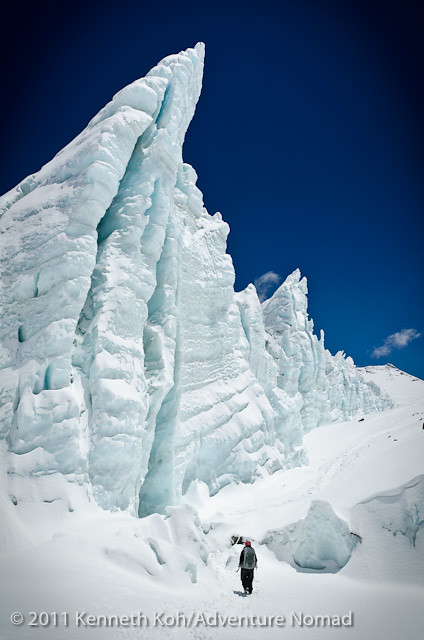
Bali, our expedition sirdar, walking beneath a serac on the East Rombuk Glacier on the way up to Advance Base Camp.  Nikon D7000, 16-85, 1/640, F/13, ISO 200.
For Everest, I brought my 'newish' Nikon D7000 with a 10.5mm fisheye, 16-85mm, 70-300mm lenses, a small tripod.  I carried this from basecamp up to Camp 1at the North Col (7000m).  Above Camp1, I used my Panasonic Lumix LX-3.  Here's a big tip:  I gave my sherpa (Jamling Bhote) an LX-3 as well, so he could get photos of me.
Everest Basecamp (5150m), China.  My tent is the one closest to camera, the white tent is the dining tent, the green tent is the toilet tent (Oops, too much detail?).  Everest has a shroud of cloud over the top in the back.  Nikon D7000, 16-85mm, 30 secs, F/7.1, ISO 800.
Here's what I learned and what I would do different:

Jamling turned out to not only be an excellent photographer, but a fine videographer as well. The experience has got me interested in shooting more video.  I'd bring a Panasonic GH2 instead of the D7000.  It's probably the best combo video/stills camera on the market today.  As a bonus, it's also smaller and lighter than the D7000, and the Micro Four Thirds lenses that it uses are smaller and lighter too. 

Lenses are a highly personal choice.  If I were bringing the D7000 the next time, I would bring my 12-24mm ultrawide and a 50mm F/1.4 instead of the fisheye and 16-85mm that I brought this trip.  But, as I said, I'd go with the GH2 next time, and I'd go with the 7-14mm and a big-aperture short- telephoto lens.
Jamling finishing breakfast at Camp 2 (7600m) on the North Ridge of Mt. Everest.  Panasonic LX3.
I could possibly carry the GH2 as high as Camp 3 (8300m), but above that, I'd still need something lighter.  Instead of the LX3 that I brought for my summit push, I'd use a GoPro instead.  I did not anticipate temperatures being so cold that I would not be able to unzip my down suit to pull out my camera, remove my goggles so that I could see the LCD, turn into the wind to snap a shot.  With the GoPro, I could set the interval timer to take a picture every 'x' number of seconds, and put the camera on my head, and hope that some of the shots would be useable.  If the weather turned out to be good, I could use the GoPro like a 5MP still camera anyway.
Here I am sitting on the very tippy-top of the world!  Image is a still captured from a video sequence with the Panasonic LX3.  The whole sequence is in the video below.
Probably the only thing I would do the same is to give my sherpa a camera.  I was lucky that my sherpa, Jamling, was so talented.  Here's a short video of the climb.  Most of the video and stills of me on Everest were taken by Jamling:

Saturday, June 4, 2011

Everest Summit Day

Traversing the North Ridge of Everest at about 8700m on the way to the summit.  Photo by Jamling Bhote.
The previous summit day of May 26th had been perfect, clear skies with hardly any wind, and quite a few climbers had topped out successfully.  Our own little expedition thus far had been meticulously planned, and our five members were feeling strong and well acclimatized, primed for our own summit attempt.  And that’s when things started to go wrong for us…


Jamling traversing the North Ridge of Everest with the summit in the back.
We arrived at Camp 3 (8300m) the day before at about 3pm.  Although the morning had been hot and still, by afternoon, the skies had darkened and snow had begun to fall thickly.  That snow would make the going more difficult during our push for the summit.  After setting up the tents, sorting out our oxygen, and getting some dinner, there was just enough time to grab a 2-hour nap before waking up for our summit push.

The weather forecast for May 27th predicted little to no wind, unfortunately, this turned out not to be the case.  Stepping out of the tent, the wind was a rude shock.  It was like a punch that took the breath out of you and made you want to immediately seek shelter. Unfortunately, there was no hiding from it, and we would find the wind to be unrelenting.  I headed upwards into the darkness.

There are a number of dead bodies along the way up Everest. Their presence are a stark reminder of how fragile human life is at this extreme altitude.  ‘Green Boots’ is the name given to the first corpse climbers would encounter at the end of the section known as the Exit Cracks.  The trail is narrow and climbers have to either step over him or gingerly around him.  He was reputedly a sherpa from Darjeeling who died on descent.  To survive, I would need to be smarter than him, or stronger, or just plain luckier.
Climbers tackling the challenging First Step (8500m) at sunrise. Photo © Jamling Bhote.
It felt windiest and coldest on the ridge just before dawn.  A few teams were huddled on the ridge just before the technically challenging First Step, trying to find some shelter from the wind, but there was none to be found and we moved on.  As we tackled the First Step, the sun was rising.  Once the sun was up, we felt better, but the wind remained the same cold, unrelenting force.
Jamling waiting our turn at the Chinese ladder of the second Step (8600m).  The wind ripping it up at the top of the step.  
We cleared the infamous Second Step at 8600m with surprising ease, and continued our traverse of the North Ridge to Mushroom Rock where we stopped to take our first break in 10 hours for something to eat and a quick drink.  It was here that we learned that only Esther, myself, and our little group of Sherpas remained.  All the others in our expedition had turned back.  We called up expedition leader, Jamie McGuiness, who said that if we were feeling ok, we could continue. 

Jamling (6-time Everest summiter and my personal Sherpa) and I had a quick discussion and agreed we were good to go on.  We got our ass in gear and reached to summit 1 1/2 hours later (27th May, 2pm Chinese time).  What followed though, would turn into quite an epic.
On the fixed ropes of the final snow slope near the summit with Pujung and Tawa behind.  Photo © Jamling Bhote.
It turns out that I was the only member to reach the summit that day with my sherpas, Jamling, Pujung, and Tawa (who wanted to summit and joined us from Esther’s group when Esther was forced to turn back just 1 1/2 hours from the summit).  The wind, consistently fierce throughout the climb, had burned my eyes when I needed to remove my iced-up goggles to climb the technical sections.  Sitting on the windy summit, they had deteriorated, and I could barely see the ground to descend.

What followed was a series of complicated tandem rappels with the 3 sherpas assisting to get me down.  They are my heroes.  Fortunately, I got my vision back after descending a bit, and was able to make my own way down slowly.  We got back to Camp 3 by sunset.
Jamling and I on the summit of Everest, 27th May 2011, 1:55pm Chinese time.  The wind is a little too strong to remove our goggles and oxygen masks. Photo © Jamling Bhote.

Thursday, April 7, 2011

30 Days of CrossFit

I've just concluded a month of CrossFit (well, four weeks to be exact), and well, I'm sold on the whole concept - CrossFit workouts and a Paleo (well... Paleo-ish) diet.  You may have seen my earlier post on CrossFit.  It kind of goes hand in hand with The Paleo Diet concept.


At the end of three weeks, I put on 2.1kg of muscle.  I  went from 63.5kg to 65.6kg while my body fat stayed the same.  That's pretty impressive results for me, as I'm a pretty hard gainer/loser.

Even more impressive is this other guy who started out at about the same time as me.  He started out weighing 130kg, and he's lost 10 kg after three weeks.  So the CrossFit/Paleo concept seems to work the body towards a caveman hunter/gatherer ideal: lean, strong, and durable.

Like all intense workouts, it's strong medicine, and I'm glad to be taking a break and heading off to climb Mt. Everest in just a couple of days.  This will be my last post for a couple of months as I won't be able to update the blog from China.  Sorry about that.  But if you'd like to follow the progress of the climb, I should be able to make updates via Twitter.

Tuesday, March 29, 2011

Supplements For High altitude Mountaineering

UPDATE: With the exception of the liver tablets, I no longer take or recommend these supplements.  Please standby for an updated post to find out what's working better for me in 2014.

Since my earlier post: Nutritional Supplements For Climbing Mt. Everest, I've learned a lot, and what I now take is significantly different, hence the need for this update.  I under-dosed a lot of the supplements in my previous post, and they didn't have the desired results.  Here's what I'm taking each day and am bringing to Everest.  As lunch is usually on-the-go, I take these in divided doses during breakfast and dinner:
Yum! Goes well with Argentinian steak. Photo by Jamie McGuiness
Mutivitamin x 2 - Now Adam (I've tried a lot of multis.  These are cheap, simple and work well for me)
Fish Oil x 4 - Controlled Labs OxiMega (double strength fish oil, reduces inflammation, 'thins' the blood, and serves as fuel)
Probiotics x 1 - Now Stabilized Acidophilus (needs no refrigeration)
Antioxidants x 2 - Now Super Antioxidants (phytoflavonoid formula.  Sometimes I don't get enough fruit and veggies)
Liver Tablets x 4 - Beverly Ultra 40 (for red blood cell production, boosts amino acid profile, and can serve as fuel.  I'll carry some extra (up to 12 per day) of these as well)
Vitamin C x 1 - Now Vitamin C-1000 (antioxidant, and reduces cortisol at night)
Mitochondria Energizer x 1 - Jarrow MityQondria CoQ10 (keeps the mitochondria fired up and become more efficient at producing energy)
Glucosamine x 1 - GNC TriFlex (joint care)

I also carry some digestive enzymes and use as required (if I have to eat a lot of carbo (rice, pasta, breads), I get gas, and the digestive enzymes help with that): Now Super Enzymes (the tablets work better than the capsules).

Specically for Everest, I'm also taking these adaptogens to help with better oxygen utilization and performance:
Garlic x 1 - GNC Triple Garlic
Ginkgo/Eleuthero x 1 - GNC Gingko Biloba Plus
Optygen HP x 4 - on climbing days

Fuel and Recovery:
  • While climbing, I use Hammer Nutrition Perpetuem, which uses soy protein instead of whey, and does not contribute to ammonia load.  Perpetuem comes in both solids and powder.  I prefer the powder which dissolves into my water bottles.  If I need solid food, I use Hammer Bars.
  • Post climb, I recover with Hammer Nutrition Recoverite.
  • I'll also bring some MRP (Meal Replacement Powder), to help maintain my bodyweight while on the mountain.
I buy most of my stuff from iHerb, and if you are a new customer, make use of this discount coupon for $5 off: KOH756

Monday, March 28, 2011

Peak Training for Mt. Everest

It seems there is no one 'best' way to train for climbing the big E.  With less than a month to go, Esther Tan, my team mate for Everest and fellow North Face athlete, took part in the Aviva Ironman 70.3 last weekend here in Singapore and placed 1st in her age group; also on our expedition is Grant Rawlinson, who is newly married (congrats dude!) and wakes up at 5am to  get in some quality training time; two-time Everest summiter and fellow Singaporean Khoo Swee Chiow, who will also be climbing the North Ridge of Everest on a separate expedition this Spring, is busy with his family and only has time for the treadmill at his gym; our guide, Jamie McGuiness, who is amazing at altitude anyway, is doing no training whatsoever.
CrossFit Prowler Push. Photo by Laura Liong.
As for me, the most of my long, hard training has been done.  After climbing Aconcagua last month, I promptly got the flu and was sick for a week.  When I was well enough to resume training, I was left with exactly one month before Everest.

It has always been part of my plan to 'peak' my training with some high-intensity work, and then taper off with some 'high-altitude' training.  With a month to go, I've combined the 'peak' and the 'taper' together.  I feel that CrossFit is the ideal training tool for this.  It's very high intensity, but also very short.  Which means that I'll reap the benefits of the high intensity work, but it won't leave me shattered and require a long recovery period. 
Training at '17,000 ft'.  Hypoxico generator and altitude tent on right. Photo by Laura Liong.
I've also bought a Hypoxico Altitude Tent and accessories which allow me to sleep and train at simulated altitude.  As time grows nearer to my departure, I'll gradually add in more 'high-altitude' training sessions, while reducing the CrossFit sessions.

So with less than two weeks to go, I hope I've got my bases covered between CrossFit and my 'High-Altitude' Training ;o)

Monday, March 14, 2011

2011 Equipment List for Climbing Mt. Everest

Fresh off Aconcagua and with Everest looming right around the corner, I'm scrambling to get my gear cleaned, organized and packed.  I'd like to thank The North Face for their support and for providing much of the needed gear for the expedition; to Rudy Project for providing eyewear; and to Hammer Nutrition.  I also need to thank many of the local shops in Singapore for stepping forward to offer discounts for gear: All Sport (Petzl headlamps and ascenders), Camper's Corner (Black Diamond Climbing Equipment), Outdoor Life and X-Boundaries.  Thanks also to Silkair for the extra baggage allowance.

My Equipment List for Climbing Everest in 2011
  • Sleeping
  • -20 Sleeping Bag - TNF Solar Flare
  • -30 Sleeping Bag - Shehe (Borrowed)
  • Mattress Inflatable - Thermarest Ultralite (old)
  • Mattress Closed Cell - Thermarest Z-Lite
  • Pee Bottle - Nalgene 48oz flexible canteen 
  • Inflatable Pillow - for BC and ABC
  • Clothing for Summit
  • Down Suit - TNF Himalayan
  • Fleece Bodysuit - MH Powerstretch Suit (zips match down suit)
  • Mitts - TNF Himalayan
  • Backup Mitts - OR Alti Mitts
  • Gloves - OR Alti Gloves
  • Socks - Smartwool Mountaineer 4 pairs
  • Boots - Millet Everest GTX
  • Balaclava - OR Gorilla
  • Beanie - TNF
  • Clothing for Lower Mountain
  • Bibs - TNF Mammatus Bibs
  • Softshell Top - TNF Kishtwar
  • Rain Jacket  - TNF Triumph
  • Rain Pant - TNF Venture Full Zip
  • Down Jacket - MH Subzero SL Hooded
  • Puffy Vest - TNF Redpoint
  • Puffy Pant - Patagonia Micro Puff
  • Fleece Tops - 2 lightweight TNF Tops
  • Fleece Bottoms - 1 lightweight stretch
  • Trekking Pant - TNF Paramount Zip Offs
  • Gloves - FA Guide Gloves
  • Boxers - 6 pairs
  • Long Underwear Tops - 3
  • Long Underwear Bottoms - 2
  • Buff - 3
  • Bunch of misc tee shirts, shorts, socks, hats and gloves
  • Trekking Boots
  • Eyewear
  • Rudy Project Guardyan (with Cat 4 lens)
  • RP Guardyan (in goggle configuration with clear photochromic lens)
  • RP Kalybro goggles (with clear and lazer bronze lenses)
  • Climbing  
  • Backpack - TNF Prophet 65
  • Ice Axe - BD Raven Pro 65cm
  • Crampons - BD Sabretooth SS
  • Harness - BD Couloir
  • Ascender - Petzl Ascension (left only)
  • Descender - BD Super 8 (frozen ropes can be a pain to squeeze through an ATC)
  • Locking Carabiners - 2 Petzl Attache 3D
  • Carabiners - 3 Camp Nano 23
  • Misc webbing, tape and cord
  • Trekking Pole - REI Peak UL
  • Headlamp - Petzl Myo RXP with lithium batteries
  • Backup Headlamp - Petzl Tikka XP 2
  • Emergency Headlamp - Petzl E+Lite
  • Eating and Drinking 
  • Cup/Bowl - GSA Fairshare Mug
  • Spoon - Brunton Ti folding spork
  • Water Bottles - 2 16oz and 1 32oz Nalgene Widemouth Bottles 
  • Thermos - TNF 0.5 liter 
  • Nutrition
  • Fuel - Hammer Nutrition Perpetuem
  • Recovery - Hammer Nutrition Recoverite
  • Bars - Hammer Nutrition Organic Bars
  • Vitamins, minerals and herbal supplements for 60 days
  • MRP - ON Oats and Whey for protein, carbs and fiber
  • Electronics and Cameras
  • DSLR - Nikon D7000 with 2 batteries, 10.5mm, 16-85mm and 70-300mm lenses
  • Compact Cameras - 2 Panasonic LX3s with 5 batteries
  • Tripod - Slik Sprint Mini
  • Phone - iPhone
  • Solar Charger - Brunton Solaris 12
      • Personal Hygiene 
      • Sunscreen - Banana Boat SPF 80 x 2
      • Lip Balm - Banana Boat SPF 35 x 2
      • Soap/Shampoo/Toothpaste - Dr Bronner's Peppermint
      • Wet Wipes - BC and ABC 
      • First Aid
      • Silver Sol - broad spectrum anti-microbial in a small spray bottle
      • Diamox - 250mg x 20
      • Ibuprofen - 400mg x 12
      • Paracetamol - 500mg x 10
      • Dexamethasone - 4mg single dose HACE
      • Nifedipine - sublingual HAPE
      • Melatonin - sublingual 2.5mg x 60
      • Cough Syrup

        work in progress...

          Saturday, March 5, 2011

          Cerro Aconcagua

          A climber at sunrise on Aconcagua
          It was our first morning at Basecamp Plaza Argentina.  I was awakened by the thumping beat of an approaching helicopter coming in to land.  I popped out of my tent to see a man being assisted into the helicopter.  Later, I would find out that he was a Polish climber with severe frostbite.  His partner was still missing on the upper mountain *.  It was a reminder that Aconcagua, considered by experienced mountaineers to be an easy 'walk up', should never be underestimated.

          Frostbitten Climber Being Assisted to the Helicopter at Basecamp

          Aconcagua, at 6962m, is the highest mountain in the Americas, as well as the highest mountain in the world outside the Himalaya.  Esther Tan and I chose to climb the False Polish Glacier Route on Aconcagua with Project Himalaya as preparation for our Mt. Everest bid next month.  We wanted to get some high-altitude experience, and get some training value (but not do something so hard it would leave us drained, physically and mentally, for Everest), as well as to evaluate Project Himalaya, as they would be managing logistics for our Everest climb.

          Esther (back) and me carrying a load up to Camp1.  Photo by Jamie McGuiness/Project Himalaya
          I wasn't disappointed.  Jamie McGuiness from Project Himalaya has a wealth of information that he is ever willing to share.  Having done mainly technical rock and ice climbs at lower altitudes, I knew little about high-altitude mountaineering.  Jamie quickly brought me up to speed on things like high-altitude medicine and acclimatization, as well as provide many small tips that only someone with extensive experience at high-altitude can provide.
          The Guru: Jamie McGuiness
          After spending four nights acclimatizing at Plaza Argentina, we left for the higher camps.  This being a non-technical climb, we were lightly loaded, carrying just crampons, but no ropes, harnesses or pro, and I didn't even have an ice-axe.  This worked out well.  The climbing, as expected, was basically a slog, but it was one tough slog at altitude, and it was made harder by unpredictable weather conditions, and an unseasonably wet and cold summer.
          Ice crystals in the wind high on Aconcagua
          On the bright side, I did manage to summit, and made a quite a few friends along the way :o)

          Summit, Aconcagua
          More photos on the climb Here.

          *The missing Polish climber was found dead near the summit of Aconcagua on March 2nd.  The 6 climber deaths on Aconcagua this season makes it one of the most deadly on record.

          Monday, December 13, 2010

          Confessions of a Peak Bagger

          "Mountaineers consider routes, peak baggers count summits."
          Bagging Alexandra Peak, Mt. Kinabalu Massif, Malaysian Borneo.  Photo courtesy of Jack Chen.
          What's a peak bagger?  It's a somewhat derogatory term used by 'real' climbers to describe a person who has no real interest in the technical difficulty of the route by which he ascends a mountain.  The primary goal of a peak bagger is to reach the summit (or a collection of summits), usually by the easiest possible route, and usually for the purpose of 'bragging rights'.

          I must confess that in wanting to climb Mt. Everest, I have become a peak bagger.  This really shouldn't come as a surprise, as I feel most climbers (myself included) choose to climb Everest not for the aesthetics of the route, but more for 'bragging rights'.   

          Heck, if there was an easy way up the mountain, I'd take it.  The thing is, there is no easy way.  The altitude makes any physical activity difficult, and even with supplemental oxygen, humans are at the limit of physical endurance near the summit.

          I've chosen to climb up the North Ridge, from Tibet, next Spring.  This is one of the 'standard' routes up the mountain, the other being the South Col route via Nepal.  In terms of technical difficulty, they are about the same.  But in terms of danger, the North Ridge surprisingly trumps the South Col.  Even though the single most dangerous place on the mountain is the Ice Fall near the bottom of the South Col route, statistically, the North Ridge is twice as deadly as the South Col (Source: The Deadly Side of Everest, Alan Arnette, 2009).

          I don't have a death wish, and the statistics are what they are.  The decision to climb from the North has more to do with marketing (and sponsors), as no Singaporean has successfully climbed Everest from the North.  So in just a few short months, Singapore's top long distance female triathlete, Esther Tan, and myself, will be heading off to climb the North Ridge of Everest with the sole prupose of 'bagging' the big 'E'.


          Monday, October 4, 2010

          Everest: Nutritional Supplements

          I wrote this article because there is so little information in the way of high-altitude mountaineering and nutritional supplements.  I did some research and I hope others will find this information useful.  Here's what I'll be fortifying my diet with when I take on the world's highest mountain next Spring. 

          Nutritional supplements have become a way of life in our modern world.  At this time, the argument isn't so much WHETHER you should supplement, but WHAT you should supplement your diet with.

          Climbing Mt. Everest has it's own challenges nutritionally.  I'll be on the Everest expedition for about 2 months next Spring, and training hard for about 6 months til then, and I've determined that to keep myself healthy, I've got to supplement my diet with some nutrients.

          I repack my supplements into small one-a-day ziplock bags, and take 1/2 in the morning with breakfast and the rest with dinner.  Here's what's in them:

          Morning* 
          1 AOR Ortho Core Multivitamin
          1 Controlled Labs Orange Triad Multi
          1 Now Vitamin C 1000mg, Buffered, Time Released, with Bioflavanoids
          1 AOR Mito Charger
          1 Beverly International Ultra 40 Liver Tablet

          Evening*
          1 AOR Ortho Core Multivitamin
          1 Controlled Labs Orange Triad Multi
          1 Now Vitamin C 1000mg, Buffered, Time Released, with Bioflavanoids
          1 AOR Ortho Bone Calcium Supplement
          1 Controlled Labs Oximega Fish Oil Capsule

          * Amazon links are provided for your information.  I have not checked out the prices.  Personally, I buy my stuff from bodybuilding.com and iHerb.com (use referral code KOH756 and get $5 off your order from iHerb.com) or TSW.com.sg.
          In addition, there are certain 'high altitude' supplements I take when I climb, and I start taking these about 2 weeks prior to when I start a high altitude climb:

          Morning
          1 GNC Ginkgo Biloba Plus Siberian Ginseng
          2 First Endurance Optygen HP Capsules

          Evening
          1 GNC Triple Garlic
          1 Digestive Enzyme


          Why I take what I take:
          The AOR Ortho Core and Controlled Labs Orange Triad are both very good multivitamin supplements.  Each has something that the other one doesn't. Orange Triad has joint aids like Glucosamine, Chondroitin, MSM, and Hyaluric Acid; Ortho Core has N-Acetyl Cysteine (NAC), a precursor to Glutathione, which in addition to being a very powerful antioxidant, may also help clear the lungs of excess mucous.  I hedge my bets and take a little of each.  A standard dose is 6 per day, but at my bodyweight of only 63.5kg (140lbs), I figure 4 per day will do*.  

          *Update Feb 2011
          Ok, this isn't working out for me.  Since changing over to the new multis, I haven't been feeling as vital.  I think I need to switch back to using a multi at full dose, but I might do something else, like NOW Adam.


          I take my fish oil supplement in the evening to prevent 'fish' burps in the day, but also because I believe the slower burning fat in the oil helps keep me warm at night.  Multivitamin supplements, together with a Fish Oil supplement, are what I recommend everyone take, regardless of whether you are climbing Mt. Everest or not!

          Vitamin C and Calcium are usually never in large enough quantities in a multi.  I've chosen to add 2000mg of vitamin C a day.  Some are going to say it is too much.  It's a personal decision.  I've tried reducing the amount, but each time I do, my old asthma creeps back in.  Through trial and error, I've found out that the minimum I need to keep my asthma (and other allergies) at bay is 2000mg daily.


          The Ortho Bone Calcium supplement is very interesting.  Although there is only 100mg of elemental calcium per capsule in this supplement, it comes in the only form of calcium shown to regrow bone (MCHC, or the Hydroxyapatite form which comes from bovine bone tissue).  The other forms (such as citrate, carbonate, etc) have only been shown to slow down bone loss.

          The liver tablet is an 'old school' bodybuilding standby.  Among other things, they are known to increase endurance.  I take one a day to help my body build blood (each tablet provides about 2mg of heme iron), as to well as add in a few BCAA amino acids.

          AOR Mito Charger is a new player on the market and brings together 3 useful micronutrients for keeping the mitochondria, or the body's energy production systems, healthy: Coenzyme Q10, R+ Alpha Lipoic Acid and Acetyl-L-Carnitine.  Currently, I'm taking these in 3 separate pills.  This one product brings it together for me in one pill, and at less cost. 


          Gingko Biloba, Siberian Ginseng (Eleuthero), Garlic and the ingredients in Optygen HP (Rhodiola and Cordyceps) are known to help acclimatize and perform in high altitude.  I only take these supplements just prior to and during a climb, and they are not part of my daily supplement pack.
           
          One of the challenges of high altitude climbing is trying to swallow pills, especially if you are nauseous.  I try to limit the number and size of the pills I have to swallow.   And because altitude can also mess around with your ability to digest food, I take a digestive enzyme with dinner, which is usually my largest meal for the day.